
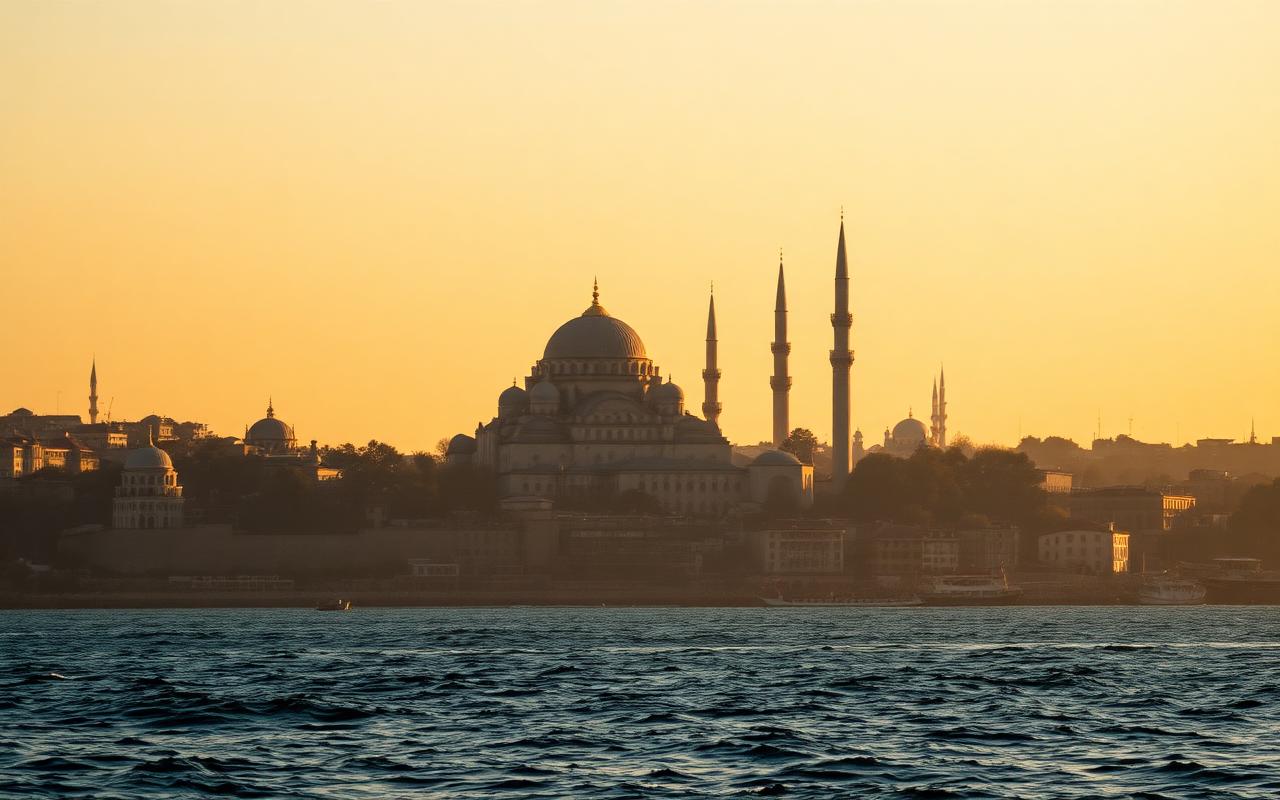
The Ottoman World
Six centuries of governance, architecture and waqf
From frontier to empire
Osman I (d. c. 1324) led a small principality in north-west Anatolia. Over the next century his successors expanded across Anatolia and into the Balkans, building an administration that absorbed local practice rather than erasing it.
1453
In 1453, Mehmed II took Constantinople after a long siege, ending the Byzantine Empire and making the city — Istanbul — an imperial capital. He rebuilt its population and economy, invited scholars and merchants, and issued guarantees to the city's Christian and Jewish communities.
The age of Suleiman
Suleiman (r. 1520–1566) is called 'the Magnificent' in Europe and 'Kanuni' (the Lawgiver) in Turkish, because his reign systematised administrative law alongside the Shari'ah. The chief jurist Ebussuud Efendi shaped that legal work.
The architect Mimar Sinan (c. 1490–1588) built or supervised hundreds of structures, including the Süleymaniye and Selimiye mosque complexes — masterpieces of dome engineering.
Waqf: the invisible infrastructure
Ottoman cities ran on waqf — permanent charitable endowments. A single complex could include a mosque, madrasa, hospital, soup kitchen, library, caravanserai and fountain, funded forever by rents from shops or farmland.
This is one of Islamic civilization's most practical achievements: welfare that did not depend on a ruler's mood.
Decline and end
From the eighteenth century the empire faced military defeats, debt, and pressure from industrialising European powers. The Tanzimat reforms (1839–1876) reorganised law, education and the army.
After defeat in the First World War, the empire was partitioned; the sultanate ended in 1922 and the caliphate was abolished in 1924. The shock of that ending shaped Muslim political thought worldwide, and still does.
Key dates
- c. 1299
Osman I establishes the beylik that becomes the Ottoman state.
- 1453
Mehmed II conquers Constantinople.
- 1520–1566
Reign of Suleiman; legal codification and Sinan's architecture.
- 1683
The failed siege of Vienna marks the limit of expansion in Europe.
- 1839–1876
Tanzimat reforms reorganise the state.
- 1922–1924
The sultanate ends and the caliphate is abolished.
People in this story
Why it matters today
The Ottoman experience shows Muslims governing a huge, diverse society for centuries — with real achievements and real failures worth studying.
- Good institutions outlast good rulers.
- Endowments (waqf) are a powerful, under-used Islamic tool today.
- Ignoring change for too long is expensive; reform under pressure is harder.
Reflect: What is one small 'waqf' — an ongoing charity — you could start or support?
How much did you discover?
0 / 2 correct
1. Mimar Sinan was:
2. Waqf refers to:
Sources & further reading
Where historians disagree, we say so. Established facts, scholarly interpretation and traditional accounts are kept distinct — please read the sources for depth.
- Caroline Finkel, Osman's Dream: The Story of the Ottoman Empire (John Murray)
- Halil İnalcık, The Ottoman Empire: The Classical Age 1300–1600 (Phoenix)
- Gülru Necipoğlu, The Age of Sinan (Reaktion Books)
- Suraiya Faroqhi, Subjects of the Sultan (I.B. Tauris)