
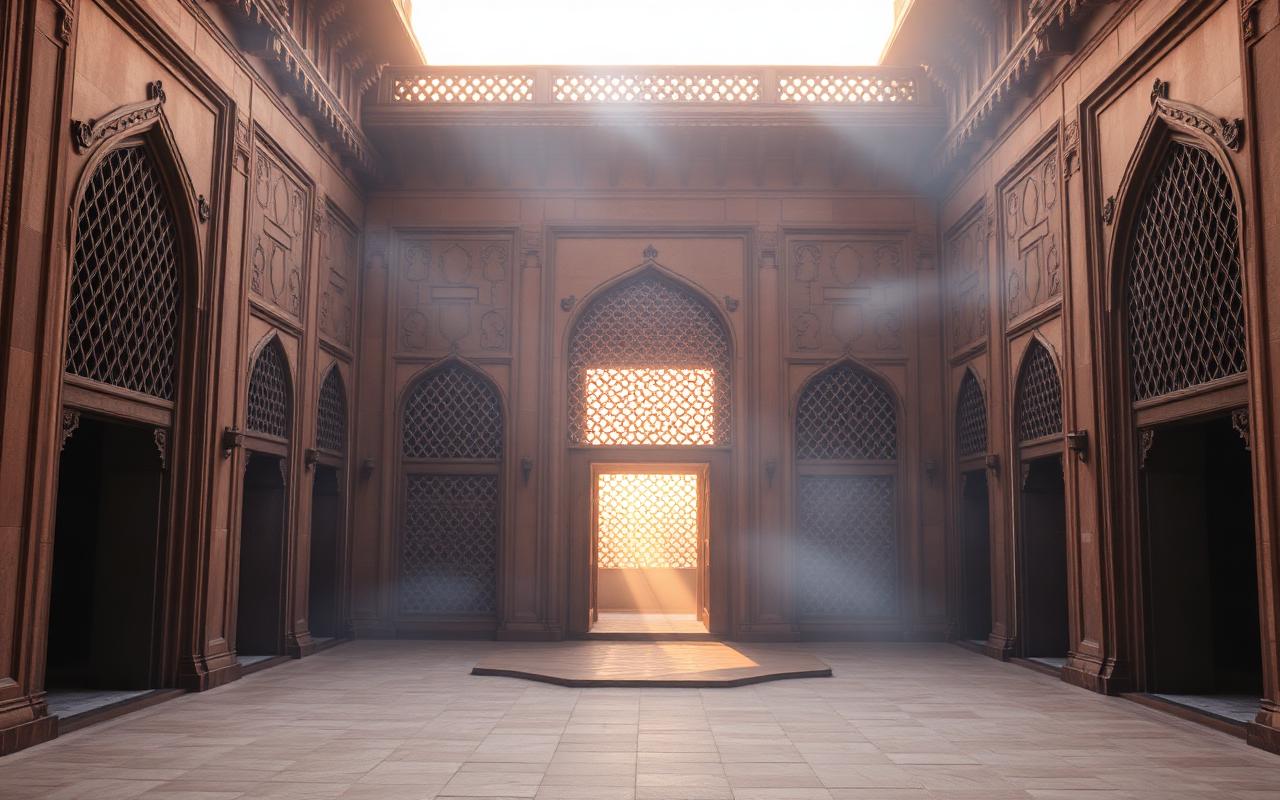
The Mughal Era
More than monuments
Foundations
Babur, a descendant of Timur and Genghis Khan, won at Panipat in 1526. His memoir, the Baburnama, is one of the earliest true autobiographies in Islamic literature. His son Humayun lost and regained the throne with Safavid help.
Akbar (r. 1556–1605) built the administrative machinery — revenue systems, provincial governance, a professional bureaucracy — that held the empire together. His religious policies were debated in his own time and are still debated by historians.
Art, letters and building
Jahangir's court advanced painting and natural observation. Shah Jahan's reign produced the Taj Mahal, the Red Fort and Jama Masjid, and Dara Shukoh translated the Upanishads into Persian.
Aurangzeb (r. 1658–1707) expanded the empire to its greatest size and commissioned the Fatawa-i-Alamgiri, a massive legal compilation. His reign is one of the most contested subjects in Indian history; serious historians disagree sharply, and honest study means reading more than one of them.
Economy and society
Mughal India produced a large share of the world's textiles and drew silver from global trade. Cities like Dhaka, Ahmedabad and Lahore were major manufacturing centres.
Persian was the language of administration; Urdu grew out of this multilingual environment and became one of the great literary languages of the subcontinent.
Decline
After 1707, succession conflicts, over-extension, regional breakaways, invasions such as Nadir Shah's sack of Delhi in 1739, and the rise of the East India Company steadily reduced Mughal power. By 1803 Delhi was under Company protection, and in 1858 the empire formally ended.
Key dates
- 1526
Babur wins the first battle of Panipat.
- 1556–1605
Akbar builds the administrative system of the empire.
- 1632–1653
The Taj Mahal is built.
- 1658–1707
Aurangzeb's reign; the Fatawa-i-Alamgiri is compiled.
- 1739
Nadir Shah sacks Delhi.
- 1857–1858
The uprising fails; Bahadur Shah Zafar is exiled and the empire ends.
People in this story
Why it matters today
The Mughal era is usually taught as buildings and battles. Its administration, economy, languages and books shaped South Asia far more deeply.
- Systems of governance matter more than personal brilliance.
- Cultural investment (language, books, art) outlives political power.
- Empires usually decline from inside before they fall from outside.
Reflect: Do you judge historical figures by one story you heard, or by reading more than one source?
How much did you discover?
0 / 2 correct
1. The Baburnama is:
2. The Fatawa-i-Alamgiri was compiled during the reign of:
Sources & further reading
Where historians disagree, we say so. Established facts, scholarly interpretation and traditional accounts are kept distinct — please read the sources for depth.
- John F. Richards, The Mughal Empire (New Cambridge History of India)
- Wheeler M. Thackston (trans.), The Baburnama (Modern Library) — primary source
- Audrey Truschke, Culture of Encounters (Columbia University Press)
- Muzaffar Alam & Sanjay Subrahmanyam, Writing the Mughal World (Columbia University Press)